Background
Africa has been projected by the United Nations’ Food and Agriculture Organisation (FAO) to be the ‘future food basket’ of the world, looking at, among others, the continent’s vast arable lands (presently holding about 60% of the world’s uncultivated arable lands) and its very youthful population (e.g., about 70% of sub-Saharan Africa is under the age of 30). However, as it stands, the continent and our country, Ghana, continue to be crippled by certain hurdles that impede the attainment of these goals—hurdles such as the lack of capital, infrastructure, and very tellingly, the endemic stark technology gap—the comparatively low application of technology to the agricultural sector along the entire value chain; challenges which are further worsened by global issues such as the climate change crisis. These hurdles obstruct the attainment of our country and continent’s fullest potentials.
And this is very evident in fields such as rice farming and production—a food commodity which, according to the FAO, over 50% of the world’s population depends on for about 80% of their food requirements. To meet this enormous demand, developing countries are estimated to produce about 95% of global rice output. But strikingly, Africa’s share of this output stands at a mere 2.6% to 4.6%. Ghana, just like the rest of the African continent, remains largely import-dependent when it comes to rice. So much for the world’s projected food basket.
To remedy this, to see to the securing for Ghana (along with the rest of the continent), the attainment of its fullest potential—i.e., effectively utilising its comparative advantages towards ensuring for itself, sustained growth, and for the world at large, food security— strategic investments, from both locals and foreigners alike, are crucial. This is a fact and mandate that we, at Nobi Agriculture, recognise and hold very dearly. Hence, the commencement of our Nobi rice farming and production project
About the Project
To amp Ghana’s rice self-sufficiency ratio from its present 40% to a much-desired export- oriented status, the country requires a total irrigation capacity of approximately 350,000 acres. We intend to very consciously and systematically contribute to the attainment of this crucial national objective. Additionally, we have invested [$ figure needed] into the acquisition of modern technology/machinery such as rice harvesters, rice transplanters, rice propellers, stone pickers, strip tills, subsoilers, etc., to enable an internationally competitive, high-quality rice farming. With post-harvest challenges being one of the country’s main obstacles to a flourishing rice production sector, Nobi Agriculture has placed a keen focus on the post-harvest processes and the adoption of first-rate quality assurance systems, making much-needed investments in the acquisition of modern technology such as paddy mills, dryers, rice polishers; the construction of modern infrastructure like mill house, warehouse, storage silos.
Nobi Agriculture has its eyes set on contributing immensely to the structural transformation of the Ghanaian economy, solving developmental challenges like unemployment, poverty, hunger, gender-bias, climate-related issues, etc., by ensuring a sustained transformation of the agriculture sector, with keen emphasis on rice production —in line with certain national, regional (e.g., Agenda 2063), and global agenda (e.g., the SDGs).And upon the receipt of the necessary funding, we intend to channel same towards, among others, further infrastructure development, acquisition of advanced machinery and
technology, working capital, and the onboarding of and the ongoing training of personnel. This, we believe, will help the attainment of these objects as enumerated above and the broad categories of objects as stated under ‘Project Component’ of the ‘Project Summary’ page.
About The Project
The Nobi Agriculture rice farming project seeks to address, head-on, the challenges faced by the Ghanaian rice production sector, while capitalising fully on the country’s comparative advantage of vast arable lands, abundant water bodies, youthful population, etc—towards the establishment of a robust, internationally-competitive rice production industry.
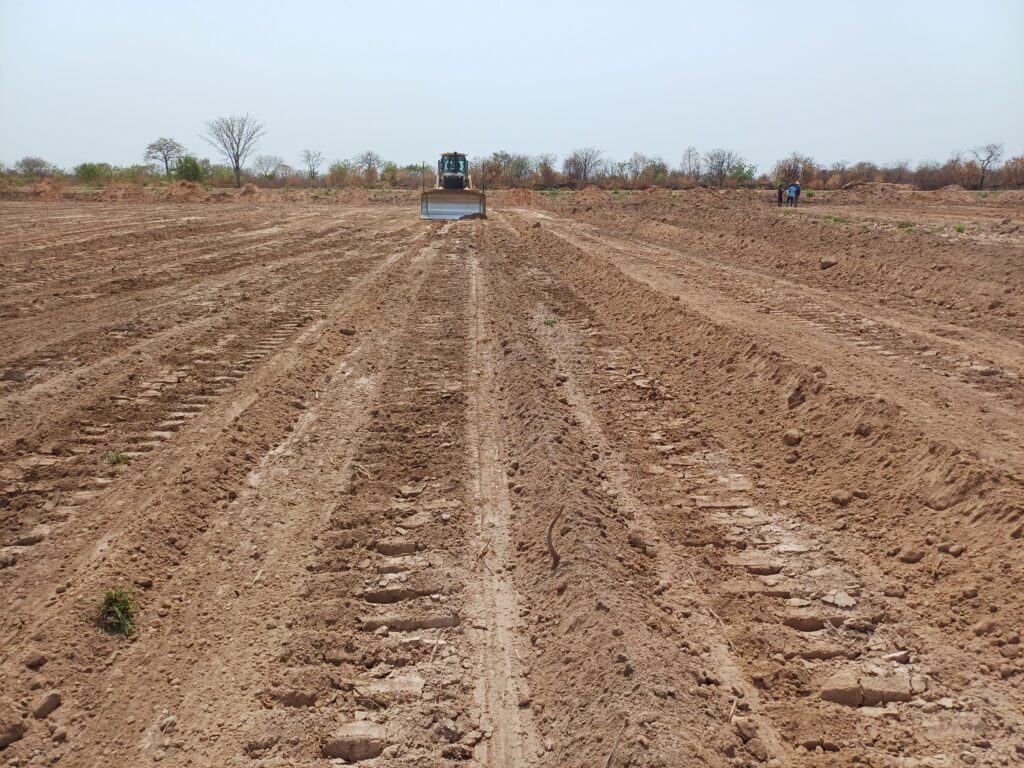
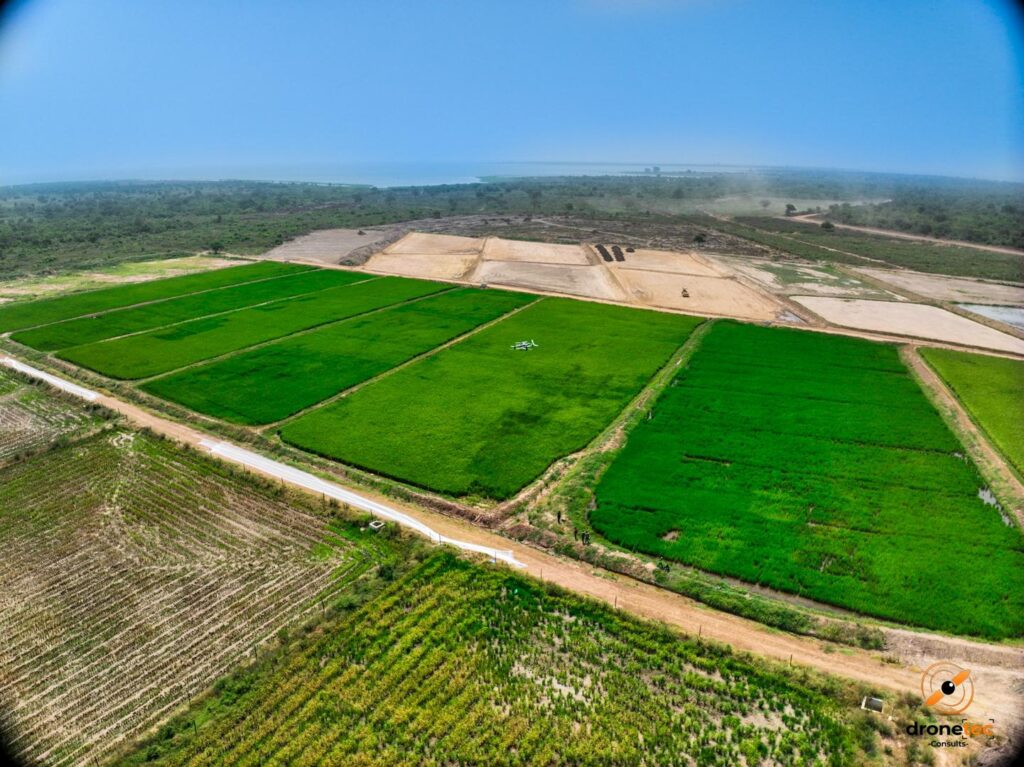
Developed on a 30,000-acre land situated in the vibrant community of Forifori within the Afram Plains South district of the Eastern Region of Ghana, this project is set to be deployed in phases, with Phase I comprising the development of a 7,000-acre rice farm, a sharp upgrade from the 300 acres presently being farmed. With this 7,000-acre phase, we project a total output of over 16,000 metric tons of rice annually, an enormous improvement from the present 900 metric tons being put out; and an increment of
jobs from the present 120 jobs created to an impressive 49,000 sustainable jobs within a three-year span. And it is for this phase (i.e., the ‘Operation 7,000 acres’ phase that we put forth this grant request).
With these goals in mind, Nobi Agriculture has invested heavily in the acquisition of the needed technology, infrastructure, personnel, etc. For instance, a total of $2.5 million has been invested towards the development of a state-of-the-art irrigation system, having an irrigation capacity of, very fittingly, 7,000 acres—with a pipeline that extends about three-and-half kilometres, from the Afram river to our ultra-modern reservoirs. Presently running on world-class hybrid pumps (using both electricity and solar), it is our plan to transition fully to solar in the next five years. The Ghanaian agriculture sector, notably, the rice farming industry, has regrettably been heavily weather-reliant—even in this climate-change-ridden era—due to the endemic lack of sophisticated irrigation systems. We intend to help remedy this problem by making our irrigation systems the subject of technology-sharing and technology-transfer partnerships with local farmers.